Showing posts with label e-books. Show all posts

Wednesday, January 09, 2013

McGraw-Hill's SmartBooks

Lily Newman … McGraw-Hill's SmartBooks: Digital Textbooks With Built-In Drill Sergeants. Interesting idea to add an adaptive learning component to e-books. Shifts it from a strictly interactive e-book to an interactive e-book that adapts to the learner.

Textbook publishing behemoth McGraw-Hill is producing a series of adaptive e-textbooks in 90 subject areas. Targeted at college-level classes, the SmartBooks quiz students as they read to establish learning style and retention and then present the material differently based on how the student is doing.

Starting at $20, the SmartBooks will be available this spring as part of a McGraw-Hill suite of adaptive and interactive learning tools called LearnSmart Advantage.


Tuesday, September 18, 2012

Create Ebooks from Wikipedia Articles

NewImage

NewImage

NewImage

Great resource from Thorin Klosowski … Create Ebooks from Wikipedia Articles for On the Go Reading Anywhere:

Ever wanted to take a few Wikipedia articles with you offline? You can now export any Wikipedia article, or a collection of articles, into a personal ebook that's readable on any device that can use the EPUB format.

To enable the create a book function, click the "Print/export" button the left side of a Wikipedia page, and select "Create a book." This starts up the book creator. From here, you can add as many pages as you like to you book by clicking the "Add this page to your book" button at the top of the Wikipedia articles you're on.

Thursday, August 23, 2012

Professor Terminated for Refusing to use E-Textbook

I'm a big proponent of e-books, but this is crazy!

For-Profit College Forces Out Arts Professor for Refusing to Adopt E-Textbook:

A professor of animation at the Art Institute of California-Orange County has been forced out of his job because he refused to adopt an e-textbook in his class that he says administrators pressured him to select, according to OC Weekly. The instructor, Mike Tracy, who had worked at the for-profit college for nearly 12 years, said he considered the $50 text “irrelevant” for his fall-term class, and took his concerns over the administrators’ requests to agencies including the U.S. Education Department. The college’s president, Gregory J. Marick, told Mr. Tracy in a letter last week that if he failed to select “an eBook from the list” for his class, he would be terminated for insubordination. Mr. Tracy was forced to resign on Tuesday.

Monday, August 20, 2012

Students Don't Want E-Textbooks ...

…when they cost as much as the print version! Duh!

Yasmeen Abutaleb … Universities Push Students To Use E-Textbooks:

Students don't seem to want to buy e-textbooks. So some schools are simply forcing them. While several colleges across the country are pushing electronic textbooks, touting them as more efficient and less cumbersome than regular textbooks, students are reluctant. 

E-textbooks still account for only 9% of textbook purchases, says Student Monitor, which researches college student behavior.

"How excited can you expect to get about an e-textbook?" Student Monitor President Eric Weil says. "It's not a fashion statement, it's not a status symbol; it has to overcome the advantages that students see (in) a printed textbook."

Typically, students don't save much when opting to buy an e-textbook. For example, an organic chemistry e-textbook costs about $100, while the print version of the same book costs just $15 more.

Thursday, July 19, 2012

Goodbye Print: E-Books Are Here to Stay

Disruption Final

From Julie Bosman … Survey Shows Growing Strength of E-Books.

Obviously, print books are not going away. They will likely become niche' or luxury products and publishers will have opportunities to add value with packaging, high-end paper, binding, print, etc. But, much like the music and movie industries were disrupted by digital content, the publishing industry is losing to e-books. Unfortunately for most traditional publishing companies, the disruption is coming from external upstarts rather than from the incumbents themselves. Had publishers had the foresight to spin out separate digital content businesses they could have been leading this shift – instead they're watching their business model crumble around them.

E-books continued their surge in popularity last year, surpassing hardcover books and paperbacks to become the dominant format for adult fiction in 2011, according to a survey of publishers released Wednesday.

For several years, consumers have been rapidly switching from print to digital for reading novels, a sign of the growing strength of the e-book for narrative, straightforward storytelling.

Over all, digital books kept up their explosive growth in 2011, the survey confirmed. Publishers’ net revenue from sales of e-books more than doubled last year, reaching $2.07 billion, up from $869 million in 2010. E-books accounted for 15.5 percent of publishers’ revenues.

But as digital revenue grew, print sales suffered, dropping to $11.1 billion in 2011 from $12.1 billion in 2010.

The annual survey, known as BookStats, includes data from nearly 2,000 publishers of all sizes. It was conducted by two trade groups, the Book Industry Study Group and the Association of American Publishers.

Wednesday, July 04, 2012

It Doesn't Look Like Windows

From Matt Warman ...Bill Gates: 'ereaders won't catch on':

Engineers brought Bill Gates an ereader prototype in 1998 – but he dismissed it because it didn’t look like Windows.

He sure does love that cash cow!

Tuesday, July 03, 2012

Making Print Irrelevant

Ben Brooks responds to Christopher Mims wish for "a credible replacement for print" in Thinking Backwards:

Mims is missing the point when he says: “credible replacement for print”. That exact line of thinking is why magazines are not thriving on the iPad. So let me lay this out as clearly as I can:

We do not need, and should not want, to replace print with digital.

We need, and should want, to find a way to make print irrelevant. [Emphasis added]

...

What would you rather have: a digital replica of a magazine — perfect replica — or would you rather have a completely new concept of what a magazine is.

The same should be true for textbooks and and books in general!

Friday, June 15, 2012

Amazon E-Books Not Such a Great Deal …

… for authors.

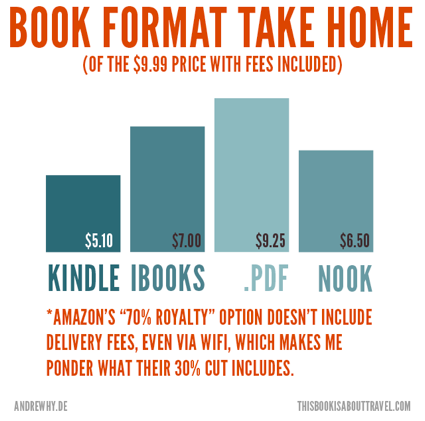
Andrew Hyde analyzes that sales data for his travel e-book. Really shocking – I had no idea! Amazon’s Markup of Digital Delivery to Indie Authors Is Around 129,000 Percent:

So my book about travel came out last week! You should buy it! A pretty exciting time.  I’ve decided to write a few posts covering the launch and lessons I’ve learned.I self published it (wrote, designed, marketed and even did the layout for it) and am really proud of the project.

This post is about the where the sales of the book are coming from, and why Amazon takes 48% of digital book sales.  Surprising eh?  I thought Amazon was the BEST for indie authors, right?

NewImage

Wait, Amazon pays out the worst? What? This can’t be right! They are the best right? Everyone loves them. I love them. I dig a bit deeper and find this little gem:

Avg. Delivery Cost ($) 2.58.

So for every $9.99 book I sell I, the author, pay 30% to Amazon for the right to sell on Amazon AND $2.58 for them to deliver the DIGITAL GOOD to your device. It is free for the reader, but the author, not amazon, pays for delivery.[emphasis added – MQ]

The file itself is under their suggested 50MB cap Amazon says to keep it under at 18.1MB. The book contains upwards of 50 pictures and the one file for Kindle needs to be able to be read on their smallest displays in black and white and their full color large screen Mac app). I’m confused. Amazon stores a ton of the Internet on S3/EC2, they should have the storage and delivery down. If I stored that file on S3/EC2 it would cost me $.01 PER FIVE DOWNLOADS. Hat tip to Robby for that one. Use Amazon to run your website: .01 to download a file. Use amazon to sell your book: $2.58 per download + 30% of whatever you sell.

(Via Daring Fireball)

Monday, June 11, 2012

Scent of a Book

NewImage

From Lauren Davis … Spritz this perfume on your e-reader to make it smell like a paper book:

For those who complain that ebooks lack the olfactory experience of opening a freshly printed book, Passion Paper has conveniently bottled the scent of ink on paper. It's meant for a person to wear, but you could easily spray a little on near your screen before you settle down with a good ebook.

Get it here

Wednesday, June 06, 2012

Ray Bradbury on E-books and Gadgets

Acclaimed Sci-Fi writer Ray Bradbury died today at 91. Here are a couple quotes I found interesting:

Via the Huffington Post

- Posted using BlogPress from my iPad

Friday, June 01, 2012

The Future of the Book

Meet Nelson, Coupland, and Alice — the faces of tomorrow’s book. Watch global design and innovation consultancy IDEO’s vision for the future of the book. What new experiences might be created by linking diverse discussions, what additional value could be created by connected readers to one another, and what innovative ways we might use to tell our favorite stories and build community around books?

Monday, May 28, 2012

PDFs and E-Books

I hate PDFs as e-books.

Chris Meadows agrees that the PDF format is [a] dead end for e-publishing:

I found an interesting article on the blog of “technology innovation company” DPCI about how PDF format is an e-publishing dead end. In an era when e-readers have so many different potential screen sizes and different text formatting and rewrapping abilities, the article notes, a format that was primarily developed to freeze a page into a form that would look the same no matter where it was printed is a dead end for screen reading.

PDF is a dead-end format. What I mean by this is that the nature of the format mimics what it was intended for: print. Once ink hits the page, the code behind it that created it becomes irrelevant because the content was not intended to move from the printed page to another system, print is the end product.

Many of the platforms that are used in digital publishing today are based on technologies like HTML in order to allow the maximum flexibility between different platforms. Storing content in such a universal way also gives the maximum flexibility for future platforms. As digital publishing is rapidly changing as is the nature of the digital space, locking content into a single dead-end format like PDF only restricts your business opportunities moving forward.

The piece also points out that many of the interactive elements Adobe has since incorporated into PDFs rely on Adobe applications and Flash to view them—which means that they don’t read as intended on mobile platforms like the iPad or Amazon tablets, and with even Adobe moving away from Flash it’s not clear how viable they’ll be into the future.

Friday, May 11, 2012

The Future of Paper Books

Michael Agresta wonders What Will Become of the Paper Book? Spoiler – he does see a future for print.

The change has come more slowly to books than it came to music or to business correspondence, but by now it feels inevitable. The digital era is upon us. The Twilights and Freedoms of 2025 will be consumed primarily as e-books. In many ways, this is good news. Books will become cheaper and more easily accessible. Hypertext, embedded video, and other undreamt-of technologies will give rise to new poetic, rhetorical, and narrative possibilities. But a literary culture that has defined itself through paper books for centuries will surely feel the loss as they pass away.

Luddites can take comfort in the persistence of vinyl records, postcards, and photographic film. The paper book will likewise survive, but its place in the culture will change significantly. As it loses its traditional value as an efficient vessel for text, the paper book’s other qualities—from its role in literary history to its inimitable design possibilities to its potential for physical beauty—will take on more importance. The future is yet to be written, but a few possibilities for the fate of the paper book are already on display on bookshelves near you.


Photo by Paul Lowry - http://flic.kr/p/4sgQpY

Friday, April 27, 2012

Apps Beat Books

I couldn't agree more!

Historian Dan Snow … I hate to say this, but apps do beat books

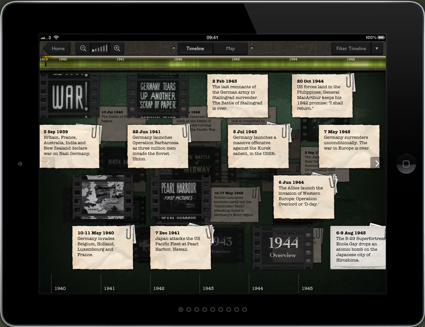
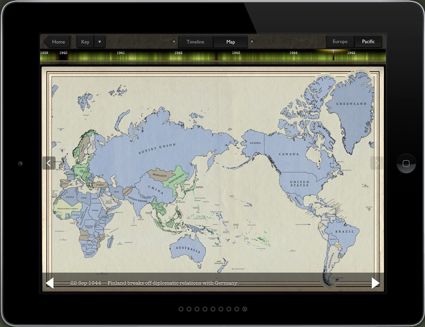
I have spent the past six months working with a team to develop an app about the Second World War, Timeline World War 2. The process has given me a profound understanding and respect for exactly what is possible. Apps on a tablet device quite simply give you all the combined benefits of books, television, the web and radio, with few of the disadvantages.

An app allows the author to use the most appropriate medium: chunks of well-written text when prose is called for to explain a key turning point; still photographs to illustrate every aspect of the war; moving film archive to bring an unparalleled immediacy, showing things like Stuka dive-bombers shrieking out of the sky; audio files of speeches; filmed eye-witness testimonies of participants; and graphic maps that show the ebb and flow of war in a dynamic way rather than as a series of static slices of time.

Timeline WW2’ is available via timelineww2.com

NewImage

NewImage

NewImage

NewImage

Wednesday, April 25, 2012

Anecdotal Data on Self-Publishing

Jesse Storimer shares his experience with 4 Months of ebook Sales … nearly $18,000 in 4 months – not too shabby!

Four months ago, to the day, I launched an ebook about Unix programming for Ruby developers. Here I'll share how it came to be and some sales numbers.


Backstory

I've been interested in writing an ebook for a while. The first time I tried I didn't finish because I couldn't stay motivated.

...

Launch

I did zero promotion before launching the book. Literally no one knew about it besides me, my wife, and a few friends. The book is fully self-published so there was no publisher involved, no copyeditor, no technical editor, just me. I'm really grateful to the few people that I reached out to who provided valuable advice and reviews. Without their interaction I wouldn't have known what I had. If I were to do this again I would certainly offer a pre-launch mailing list to let people follow along as I worked on the book.

I was very nervous about putting something out there with my name on it and asking people to pay money for it. Once the book was 'done' I deliberated for a month on whether or not I would release it. After putting together a web site for the book (with the help of Copywriting for Geeks) and showing it to one more person who gave really positive feedback I decided to bite the bullet and see what would happen. I treated the whole thing as an experiment and had no idea what to expect.

Someone close to me asked what I would consider to be a successful outcome after launching the book. At first I said that if I can create something, put it online, and get even one person to pay for it then that's a huge accomplishment. After some thought I said that if the revenue were $1,000 in the first month (about 1 sale per day) I would consider it a success. To my surprise revenue was just over $1,000 on launch day alone. The only launch announcement I made was via Twitter.


Numbers
  • Total Revenue: $17,992 USD
  • Total # of Sales: 746

WWUP sales to date

Thursday, April 19, 2012

Digital Books Taking Over

Luke Wroblewski with some interesting data on e-books … Data Monday: E-reading E-books
it's clear digital books are taking over.
  • In January 2011, publishers sold 3.9 million children’s and young adults e-books. One year later, that monthly sales figure is up to 22.6 million. (source)
  • Adult book sales also grew from 66.6 million e-books sold in January 2011 to 99.5 million sold in January 2012. (source)
  • This past January, paperbacks outsold e-books by less than 6 million units; if e-book market growth continues, it will have far outpaced paperbacks to become the number-one category for U.S. publishers. (source)
  • In mid-December 2011, 17% of American adults had reported they read an e-book in the previous year; by February, 2012, the share increased to 21%. (source)
  • Ownership of e-book readers like the original Kindle and Nook jumped from 10% in December to 19% in January and ownership of tablet computers such as iPads and Kindle Fires increased from 10% in mid-December to 19% in January. (source)
  • 29% of Americans age 18 and older own at least one specialized device for e-book reading – either a tablet or an e-book reader. (source)
  • 30% of those who read e-content say they now spend more time reading, and owners of tablets and e-book readers particularly stand out as reading more now. (source)
  • 29% of readers of e-books consume their books on their cell phones. 23% of readers of e-books consume their books on a tablet computer. (source)
  • Amazon has sold over two million Kindle Singles: e-books that are shorter than full-length books but longer than most magazine articles. (source)

Tuesday, April 17, 2012

Fixing Technical Books

Owen thinks Technical Books Are Broken. I agree, but I think his solution of on-demand print books doesn't really solve the problem. I think enhanced e-books with rich interactive elements would do so much more to address the issues with print books. The problem with e-books that he identifies has more to do with trying to recreate the print book experience in an e-book, versus using e-books to redefine what a book is.
Technical books also go stale very quickly. Even my copy of the above HTML reference is already out of date. It doesn't include the common HTML5-specific tags like section and header. And as the HTML5 standards change (like any technical topic does - very quickly), the book becomes more and more stale. Offering online supplements to the books keeps the information that the "book" offers more fresh, but then, is that really the book? If I wanted an online reference, and let's face it -- there are plenty of great, free online HTML5 references, wouldn't I choose one of those instead of paying for a hardcover book?

The main issue I have with technical books is that their digital incarnations are insufficient. We've somehow failed to develop a useful transition from paper to digital that includes a useful way to integrate the two mediums. The online versions tend also to be very poorly formatted for use when at the terminal. I actually despise using the Kindle version of most technical books because they're not anywhere near as handy as flipping paper pages. The mere thought that the paper version works better indicates to me that something is wrong with the UX of the digital version.


Friday, March 30, 2012

Are E-Books as Effective as Print Books?

While the web (and traditional e-books) do lack "spatial navigability", enhanced e-books delivered on touchscreen devices are clearly different. Not only do they require a user to touch the screen to navigate the book, but interactive elements (3D objects, video, audio, assessments, animations, simulations, etc.) provide opportunities to build additional connections with the content – and hopefully to improve student success.

NewImage

based on David Eaglemans' Why the Net Matters?

From Andrew Sullivan … E-Book Amnesia:

Neuroscientist Mark Changizi explains how e-books, like much of the web, lack spatial navigability, which can be key to remembering information:

We don't navigate the web so much as beam hither and thither within it. Can't find your way to the ticket site? No matter, you can Google-beam directly there by typing in the name. And not only is the web not spatial or navigable, but the new reading experiences within documents have lost their spatial sense as well. ... Need to jump to that part of the book where they discussed cliff jumping? You will get no help from the local topography, but you can beam yourself directly there via a within-document text search.

Screen size also matters:

[Jakob Nielsen, a web "usability" expert,] says that studies show that smaller screens also make material less memorable. "The bigger the screen, the more people can remember and the smaller, the less they can remember," he says. "The most dramatic example is reading from mobile phones. [You] lose almost all context."

Monday, January 23, 2012

Why All the Anti-Apple Sentiment Over iBooks Author?

NewImage
Ed Borasky doesn't think much of Apple's new initiatives in education – This Is How You Disrupt Education, Not iBooks Author!:
My take is that it was 100% Apple marketing and zero “disrupting education.” It was all about selling overpriced tablets to schools that are struggling to keep teachers on the payroll. It was all about forcing authors to buy new Macintosh machines or upgrading existing ones to MacOS X “Lion”. And it was about a restrictive EULA for authors.
Of course Apple is in the business of selling their products, but if you've experimented with or even watched the videos demoing the new iBooks or iBooks Author, it's hard not to think that these will impact what we do as educators. To cynically dismiss iBooks2, and iBooks Author as "100% Apple marketing" is missing the mark and way too hyperbolic.
As for the restrictive EULA (End User License Agreement), it has gotten a lot of press, but much of it overhyped. If you create an ibooks e-book (that will only work on the iPad) and you want to sell it, you have to sell through Apple – just like you would an iOS app. If you want to give it away for free, there are no restrictions. As for fears that the the EULA gives Apple ownership of your content, that's just reading way too much into the terms and extrapolating them to the most draconian outcome. I've read the EULA and I don't see it. Your content is yours; you can do whatever you want with it. If you choose to produce a rich, interactive multimedia e-book using iBooks Author you can either give it away or sell it through Apple. Want to sell it for the Amazon Kindle, use another tool to format the book and publish to Amazon. How's that different from an app developer? Sure, I'd like to see Apple put this all to rest by revising the EULA, but even as is, people are reading way too much into it.
He points to a couple alternatives that he feels are truly disruptive – (1) free textbooks:
Textbooks should be free! That’s one way to disrupt education. And CK12.org provides Science, Technology, Engineering and Mathematics (STEM) textbooks for free. These are textbooks developed by educators, not marketers. They work on iPads, Kindles, PDF readers, or you can read them on line in your browser. There are authoring tools on the web site as well. The current CK-12 FlexBooks Library lists 38 mathematics textbooks, 34 in science and 20 in other subjects. Some have both student and teacher editions.
and (2) free software:
And education software should be free! The most comprehensive collection of free educational software I’ve found is openSUSE Linux for Education – openSUSE:Education-Li-f-e. This is a LiveDVD that will boot on most PC-based hardware with at least 1 GB of RAM.. You don’t even need a hard drive – since it’s a Live DVD, Li-f-e doesn’t touch the hard drive unless you explictly direct it to do so. If you want, you can copy the DVD to a USB drive and boot from that.
and he concludes …
Given that these free tools exist, and have been around since well before the iPad, I don’t see how Apple marketing can claim to be disrupting education. There’s real disruption if you know where to look.
Where do I start? Free is great, free books, free software, but that doesn't necessarily mean free is best. If these tools (free books and open source software) are truly disrupting education, where the data. Where's the proof? Open source software has been around forever – I teach Linux, so I interact with open source every day, but my colleagues in education? No so much. Maybe MoodleRooms has made a tiny dent in the Blackboard empire, but teaching your classes using a Live Linux distribution – as Borasky suggests – it just not happening.
The books available through CK12.org look promising, but a few questions:
  1. where's the multimedia, the interaction – since these are web-based, this would be a great opportunity to include content and resources to enrich the e-books, but instead these appear to be no different than print books except for the fact that they're free, online, and include few links to external resources,
  2. the textbooks can be downloaded as PDFs, as ePub files for iPads and other readers, or purchased (for $0.00) from Amazon's Kindle store,
    • Why not offer as a .mobi file to download directly to the Kindle?
    • Why is it OK to distribute through Amazon, but not Apple? Is Amazon less evil?
    • Do kids need Amazon accounts, and credit cards to access these materials?
  3. The CK12 project seems to have been around since 2007. If as Borasky claims, "there's real disruption if you know where to look", how many school districts, teachers, students, etc are using CK12 textbooks?
So we've had free – books and software – but not disruption. That doesn't mean that iBooks, iPads, and iBooks Author are the answer, but let's at least give it a shot.

LinkWithin

Related Posts Plugin for WordPress, Blogger...