Showing posts with label Wireless. Show all posts

Saturday, December 29, 2012

Wireless Coverage Maps

Interesting stuff from Benjamin Kerensa ... The Shocking Truth About Wireless Coverage Maps


Awhile back I blogged about some excellent crowdsourced coverage maps available to customers of major wireless carriers and today I put together this infographic on the state of coverage maps provided by the carriers AT&T, Sprint, T-Mobile and Verizon. The inaccuracy of coverage maps does not just exist with major carriers but it’s also a problem with smaller carriers too.


- Posted using BlogPress from my iPad

Thursday, December 06, 2012

Smart Wi-Fi Routers

Interesting development from Bill Ray … Wi-Fi routers able to manage bandwidth by app are offered:

The latest wi-fi routers know which applications are asking for wireless connectivity and can prioritise those that matter while still letting data trickle to those which don't.

The technique, which maker Aruba calls "AppRF", looks at the packets to work out what each wi-fi client is doing, allowing the enterprise to decide which applications get priority access - so the busy BOFH can throttle the executives' video conferencing while ensuring his Call Of Duty pings remain low. Encrypted comms, such as MS Lync, are fingerprinted and so can be equally controlled even if the content of each packet is obscured.

Wednesday, October 31, 2012

FCC: 25% of Cell Towers Hit by Sandy Still Down

I've had to resort to text messaging to communicate with my wife and daughter. Interestingly, friends with Verizon (we have AT & T) are having fewer issues.

From Alex Fitzpatrick ...25% of Cell Towers Hit by Sandy Still Down:

A quarter of the cell phone towers damaged by Superstorm Sandy are still down, the Chairman of the Federal Communications Commission told reporters in a press call this afternoon. The affected towers lie in 158 counties across 10 states, from Massachusetts down to Virginia.

If you're in a badly-hit area with little-to-no cell service, don't expect things to get better quickly: FCC Chairman Julius Genachowski noted during the call that many cell towers in areas without electricity are running on backup generators -- generators which will begin failing in the near future as batteries run dry.

2048 QAM

Martin Sauter on 2048QAM Over The Air. Wow!

Quadrature Amplitude Modulation, or QAM for short, is a modulation technique used by systems such as UMTS, LTE and also by microwave backhaul systems. UMTS and LTE use QAM, 16QAM and 64QAM to encode 2, 4 or 6 bits per transmission step. And 64QAM already pushes the limits quite hard and is only used when a user is very close to the base station.

The highest modulation technique I have heard about for microwave Ethernet backhaul systems to transfer data back and forth from and to the cellular base stations so far is 256QAM, i.e. 5 bits per transmission step. This is possible due to the very directional focus of the radio beam versus sectorized transmission in cellular systems.

Now Dragonwave is saying that their latest system is capable of 2048QAM, i.e. 11 bits per transmission step. Further numbers cited in the article match that claim. A peak throughput of 550 Mbit/s over the channel mentioned in the article would mean that a 50 MHz channel is used for data transmission. Quite a fat pipe but not unheard of for microwave backhaul (see also link above).

An incredible number from today's perspective despite the directional nature of the transmission and pushes the state of the art quite a bit.

P.S. The latest version of Wi-Fi, 802.11ac uses 256QAM for very good signal conditions.

Tuesday, October 16, 2012

Logitech's Broadcaster WiFi Webcam

NewImage

Nice!

From Steve Dent … Logitech announces $200 Broadcaster WiFi webcam for iPhone, iPad and Mac (video):

Logitech has formally outed the HD WiFi Broadcaster webcam. The 720P shooter (not 1080p as we hoped) allows wireless transmission from 50 feet away to any Mac computer, iPhone or iPad, instant broadcasting on Ustream and the ability to toggle between your device or computer's built in camera with a button push. The hard plastic carrying case with a magnetic lid doubles as a stand to elevate the cam, which Logitech says will "play nicely" with apps like iMovie, Final Cut Pro and FaceTime. Broadcaster is already up for preorder for $200 in the US

Friday, August 17, 2012

Verizon Spending $3.6bn on Cable Spectrum

Verizon's smart, they know where the future is. Building out FIOS may have been a misstep, but building more wireless capacity will position them well.

From Neil McAllister … Verizon wins approval for $3.6bn cable spectrum swap:

Verizon looks to have the green light to acquire around 20MHz of wireless spectrum from a consortium of four of the US's largest cable companies, with two government agencies having voiced approval of the deal, albeit in modified form.

The deal, which would see Verizon spending $3.6bn to acquire spectrum licenses from Bright House Networks, Comcast, Cox Communications, and Time Warner Cable, has been opposed by labor unions, public interest groups, and competing companies, who claim it would be anticompetitive and cost jobs.


Tuesday, August 07, 2012

BIll to Study and Regulate Radio Frequency

Kucinich introduces RF regulation bill to Congress:

On Friday, Representative Dennis Kucinich (D-OH) introduced bill HR 6358 to Congress, which could spawn a new national research program to study cell phones and force the FCC and EPA to update the Specific Absorption Rate methodology for determining the potential damage that radio frequency emissions can cause. The bill, should it be passed, will "examine, label, and communicate adverse human biological effects associated with exposure to electromagnetic fields from cell phones and other wireless devices, and for other purposes."


Friday, July 20, 2012

An Innovative Proposal to Share 1000 MHz of Spectrum

From Jon Brodkin – Bold plan: opening 1,000 MHz of federal spectrum to WiFi-style sharing:

An advisory council to President Obama today said the US should identify 1,000 MHz of government-controlled spectrum and share it with private industry to meet the country’s growing need for wireless broadband.

The report from the President’s Council of Advisors on Science and Technology (PCAST) says the "traditional practice of clearing and reallocating portions of the spectrum used by Federal agencies is not a sustainable model." Instead, spectrum should be shared. For example, the government might need a chunk of spectrum for communications and radar systems in certain places and certain times—but "that spectrum can be freed up for commercial purposes at other times and places while respecting the paramount needs of the Federal system."

If put into place, the plan would represent a major change in how the US government uses and distributes spectrum, one that will help power our future filled with 4G phones and tablets. Spectrum sharing is a concept already embraced by TV white spaces technology, which is sometimes called "Super WiFi" and uses empty TV channels instead of traditional WiFi frequencies. The PCAST recommendation is that sharing shouldn’t be the exception—it should be the norm.

...

PCAST said it has already identified more than 200MHz of federal spectrum that can be freed for sharing. Another 195MHz will be identified in a report coming later this year, and the Federal Communications Commission will use incentive auctions "to free up substantially more prime spectrum," the council noted.

PCAST recommended allowing "general authorized access" devices to operate in the 3550-3650 MHz band (used for radar). It also identified the following list of bands as being potentially suitable for shared use:

NewImage

Monday, July 16, 2012

Sprint's 4G LTE Network

They need to move much faster with their rollout.

From Nathan Olivarez-Giles … Sprint's 4G LTE Network Launches in 5 Markets:

Sprint’s 4G LTE service finally launched on Monday, but finding it won’t be easy. As of day one, Sprint 4G LTE is live in just 15 cities in five markets.

Seven of Sprint’s first 4G LTE cities are located in Texas — Dallas, Fort Worth, Granbury, Houston, Huntsville, San Antonio and Waco. Six are in Georgia — Atlanta, Athens, Calhoun, Carrollton, Newnan and Rome. And the last two are in the Kansas City market of both Kansas City and St. Joseph, Missouri. Sprint plans on launching its 4G LTE service in more markets before the end of the year, though it didn’t say when or where.

While Sprint has offered 4G service since 2008, its previous 4G networks ran on slower, older networking technologies — WiMax and HSPA+.

Tuesday, June 26, 2012

Researchers Demonstrate 2.5 Terabits Per Second Wireless

NewImage

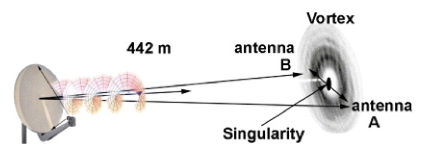
From Sebastian Anthony – Infinite-capacity wireless vortex beams carry 2.5 terabits per second:

American and Israeli researchers have used twisted, vortex beams to transmit data at 2.5 terabits per second. As far as we can discern, this is the fastest wireless network ever created — by some margin. This technique is likely to be used in the next few years to vastly increase the throughput of both wireless and fiber-optic networks.

These twisted signals use orbital angular momentum (OAM) to cram much more data into a single stream. In current state-of-the-art transmission protocols (WiFi, LTE, COFDM), we only modulate the spin angular momentum (SAM) of radio waves, not the OAM. If you picture the Earth, SAM is our planet spinning on its axis, while OAM is our movement around the Sun. Basically, the breakthrough here is that researchers have created a wireless network protocol that uses both OAM and SAM.

In this case, Alan Willner and fellow researchers from the University of Southern California, NASA’s Jet Propulsion Laboratory, and Tel Aviv University, twisted together eight ~300Gbps visible light data streams using OAM. Each of the eight beams has a different level of OAM twist. The beams are bundled into two groups of four, which are passed through different polarization filters. One bundle of four is transmitted as a thin stream, like a screw thread, while the other four are transmitted around the outside, like a sheathe. The beam is then transmitted over open space (just one meter in this case), and untwisted and processed by the receiving end. 2.5 terabits per second is equivalent to 320 gigabytes per second, or around seven full Blu-ray movies per second.

...

According to Thide [researcher Bo Thide of the Swedish Institute of Space Physics], OAM should allow us to twist together an “infinite number” of conventional transmission protocols without using any more spectrum. In theory, we should be able to take 10 (or 100 or 1000 or…) WiFi or LTE signals and twist them into a single beam, increasing throughput by 10 (or 100 or 1000 or…) times. For fiber networks, where we still have a lot of spare capacity, this isn’t all that exciting — but for wireless networks, where we’ve virtually run out of useful spectrum, twisted radio waves could provide an instant, future-proof solution. For the networking nerds, Willner’s OAM link has a spectral efficiency of 95.7 bits per hertz; LTE maxes out at 16.32 bits/Hz; 802.11n is 2.4 bits/Hz. Digital TV (DVB-T) is just 0.55 bits/Hz.

Photo from New Journal of Physics


Wednesday, June 06, 2012

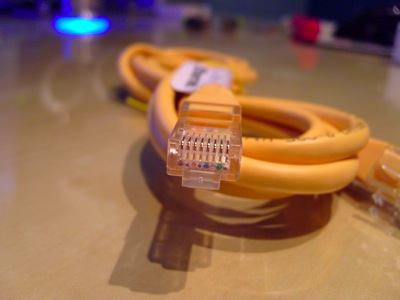
Wirelessly Transfer Data at 2 Gbps

Ethernet

Not today or tomorrow, but soon. And with 802.11ac and 802.11ad coming, the future for wireless looks very bright. Cables could quickly become a thing of the past.

John Chan … 2Gbps Wireless Chip

Scientists from Singapore’s Nanyang Technological University (NTU)’s Virtus IC Design Centre of Excellence have announced a new microchip called Virtus (named after the design center) that promises up to 2Gbps wireless data transfers in mobile devices. This will theoretically allow users to transfer 1GB worth of data in under 5s. Not only would this make copying music and videos to and from phones painless, it could also be used to make streaming content from mobile devices to TVs and projectors more convenient.

The Virtus meets the upcoming IEEE 802.11ad standard, which is complementary to current Wi-Fi technologies such as 802.11n and the latest 802.11ac . The latter two work in the 2.4GHz and 5GHz spectrums, and are widely used for Wi-Fi networks. 802.11ad, however, uses the 60GHz spectrum and has the potential for much higher transfer speeds. The downside is that it has limited range and wall penetration, and is thus more suitable for short distance device-to-device communications.


Photo by DeclanTM - http://flic.kr/p/4cDczK

Monday, June 04, 2012

802.15.6 - BAN: Body Area Networking

We can add this new acronym to PAN, LAN, WLAN, WAN, etc

From Shuang Yu - IEEE 802.15.6, A New Standard for Body Area Networking

IEEE, the world’s largest professional association advancing technology for humanity, today announced a new standard, IEEE 802.15.6™-2012, optimized to serve wireless communications needs for ultra-low power devices operating in or around the human body. Created for a variety of applications, IEEE 802.15.6-2012 is designed to address and compensate for the effects of a body on network performance. It will help enable a new generation of wireless implantable devices, assist in the development of new opportunities for delivering better healthcare as well as support other innovative uses for wearable computing devices.

- Posted using BlogPress from my iPad

Thursday, May 17, 2012

3Gbps Wireless Demoed in Japan

Megan Geuss reporting … Terahertz frequencies bring Japanese researchers 3Gbps in a WiFi prototype

:

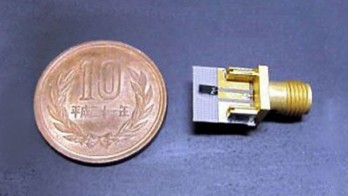
The terahertz wireless radio is small enough to fit in portable devices.

A team of researchers at the Tokyo Institute of Technology have transmitted data on the terahertz range of spectrum using a wireless radio no bigger than a 10-yen coin (roughly the size of a penny). The tiny contraption can access spectrum between 300GHz and 3Tbps (otherwise known as T-Rays for terahertz), and was able to transfer data at a speed of 3Gbps. But this was only a test run—researchers suspect that using terahertz spectrum could get data transfer up to rates of 100 Gbps.

Thursday, May 10, 2012

Anti-Wi-Fi Wallpaper

NewImage

Very cool!

Evan Ackerman … Anti-Wi-Fi wallpaper is the ultimate in network security:

Trust me, all of your neighbors have already figured out that the password to your Wi-Fi network is the name of your cat, and they're busy pirating movies and software and when the MPAA breaks down the door you're the one who's going to a labor camp in Siberia. Don't let this happen to you, install wallpaper that keeps your Wi-Fi contained.

This wallpaper contains special patterns of silver crystals that have been arranged to block certain wireless frequencies, specifically, the frequencies that your Wi-Fi router operates in. When the wallpaper goes on sale in 2013, it'll cost about the same as mid-range traditional wallpaper, and if you don't like the snowflake pattern, you can cover it up with paint or whatever. This particular version doesn't block phone signals, but by altering the silver pattern, it can be tuned to screen out whatever frequencies annoy you most.

via Gizmodo

Tuesday, May 08, 2012

Data Speeds for AT&T, Sprint, T-Mobile, and Verizon

From Mark Sullivan … 3G/4G Performance Map: Data Speeds for AT&T, Sprint, T-Mobile, and Verizon:

Click the map for our neighborhood-by-neighborhood speed test results, as well as Web page and video load times, at each of our 127 testing locations in 13 cities.

How to Use the Map: We tested wireless service in 13 cities, and in each city we tested in ten locations. The map below displays our test results for each location.

To zoom in on a city, use the navigation controls at the upper left of the map, or click repeatedly on or near the group of map pins.

Click the blue pins to display the results. You'll find download and upload speeds (in megabits per second), network latency (in milliseconds), and Web page download and video stream times (in seconds) for both the 3G and 4G services of the four national wireless carriers.


View 3G/4G Wireless Tests in a larger map

Saturday, December 24, 2011

802.11 Packets in Packets

A new wireless exploit from Travis Goodspeed - 802.11 Packets in Packets

New to 2011, Packet-in-Packet exploits allow for injection of raw radio frames into remote wireless networks. In these exploits, an attacker crafts a string that when transmitted over the air creates the symbols of a complete and valid radio packet. When radio interference damages the beginning of the outer packet, the receiver is tricked into seeing only the inner packet, allowing a frame to be remotely injected. The attacker requires no radio, and injection occurs without a software or hardware bug.

This lecture presents the first implementation of Packet-in-Packet injection for 802.11B, allowing malicious PHY-Layer frames to be remotely injected. The attack is standards-compliant and compatible with all vendors and drivers.

Unlike the simpler implementations for 802.15.4 and 2FSK, 802.11B presents a number of unique challenges to the PIP implementer. A single packet can use up to three symbol sets and three data-rates, switching rates once within the header and a second time for the beginning of the body. Additionally, a 7-bit scrambler randomizes the encoding of each packet, so the same string of text can be represented 128 different ways at the exact same rate and encoding.

This lecture presents the first implementation of Packet-in-Packet injection for 802.11B, allowing malicious PHY-Layer frames to be remotely injected. The attack is standards-compliant and compatible with all vendors and drivers.


- Posted using BlogPress from my iPad

Thursday, December 15, 2011

Congress Mulling Restrictions on Additional Unlicensed Spectrum

Stacey Higginbotham reporting … Congress Wants to Kill Super Wi-Fi and White Spaces, Too:

The spectrum bill that passed the House last night will make any technologist weep. I know the tech community is upset over the Stop Online Piracy Act (SOPA), but this bill represents a somewhat geekier threat–killing more unlicensed spectrum. So Silicon Valley may want to get active over this one too. The House version of the bill will ensure that none of the airwaves auctioned off from the digital TV band will be used for unlicensed wireless, where services such as Wi-Fi or white spaces broadband exist.

Free airwaves are good for innovation.

Unlicensed spectrum are the free airwaves that any company can use as long as the it meets certain FCC guidelines. The 2.4 gigahertz and 5 gigahertz bands that Wi-Fi currently works in are unlicensed, as are the 900 Mhz bands used by baby monitors and cordless phones. But under the bill passed last night, none of the megahertz the government gets back from TV broadcasters will be set aside for such use, and instead would end up getting auctioned off to licensed users, such as a network operator.

That’s bad for a variety of reasons, specifically because some of those bands are supposed to be used for delivering Super Wi-Fi or white spaces broadband.

Friday, December 02, 2011

Verizon Gets More Spectrum to Expand LTE/4G

Terrence O'Brien reporting – Verizon scores new spectrum from Comcast, Time Warner and Bright House for $3.6 billion:

Verizon has a pretty serious head start in the LTE race. To make sure it stays at the front of the pack, Big Red has entered an agreement with SpectrumCo (a joint venture between Comcast, Time Warner and Bright House) that sees 122 AWS spectrum licenses transferred to the carrier for $3.6 billion and some commercial agreements. The deal will allow the companies to become authorized retailers for each others products, eventually giving the cable companies the ability to offer Verizon Wireless service as wholesalers. For its part, the House that Droid Built scores a boat load of new spectrum that may become crucial in expanding its network and ensuring that speeds don't drop off significantly as more customers transition to 4G.

Netspot – Free WiFi Site Survey Tool for Mac

Great tip and video from Alan Henry!


Netspot for Mac Makes Diagnosing Wi-Fi Signal Problems Quick, Easy, and Free
:

Everyone has decent Wi-Fi signal when they're sitting in the same room as their wireless router, but what about across the apartment, or in the basement? If you think you should have signal but don't, free site survey app Netspot is a utility that gives you the tools to draw out your floorplan, walk about your home or office with your laptop, and survey network strength, available networks, and channels in use along the way.

The app starts you off with a drawing tool where you can lay out the floorplan of your home or office. Once you've given it a rough idea of how your space is laid out, you can click any spot on the map to have the app scan the area for available wireless networks, their network type, the signal strength for each network, and more. The app will save the information behind the scenes, and you can move on to the next spot in your space to test. After you've covered the whole area, Netspot will show you where your wireless signal is the strongest, where it seems to drop off, and even give you a color-coded heatmap of your space so you can see where signal is the strongest and where you may need to install a repeater for a little signal boost.

Netspot is pretty powerful for a free utility, and gives you a great deal of information about the wireless networks in your area that you can use to decide which channel your network should be on and where you should position your wireless router. Best of all, it's completely free.

Netspot


Tuesday, November 29, 2011

WiFI News: Ruckus Wireless Introduces ChannelFly

Stephen Lawson reporting –

Ruckus Tackles Channel-changing in Wi-Fi:

Ruckus Wireless took another shot at optimizing Wi-Fi capacity on Monday, introducing a technology called ChannelFly that is designed to place network clients on the best possible channel based on the actual capacity of that channel.

Because Wi-Fi uses unlicensed radio spectrum, Wi-Fi networks are susceptible to interference from Bluetooth devices, microwave ovens and other spectrum users, as well as from other Wi-Fi systems. The two bands where it works, in the 2.4GHz and 5GHz ranges, can be divided into several channels. But the growing number of Wi-Fi devices and networks all have to contend for the use of those channels.

Intelligently assigning clients to the various channels is one way of making the best use of a network's capacity, and other vendors have targeted this solution. For example, in 2008, Aruba Networks introduced its Adaptive Radio Management 2.0 network management software, one purpose of which was making better channel assignments. Ruckus, which pioneered beamforming, another Wi-Fi optimization technique, said it has taken a new approach to picking channels with ChannelFly.

The software, which is available free for all Ruckus access points, determines how long it takes each packet to traverse the network in order to gauge the performance offered by each channel. It uses both current and cumulative results to predict which channel will be the best for a client to use. The access point communicates a change of channel to the client via the IEEE 802.11h standard.

By contrast, most other channel selection systems involve an access point passively listening for evidence of interference or congestion in adjacent bands, said David Stiff, director of product management at Ruckus. ChannelFly directly measures the impact of interference or congestion on actual packets.

LinkWithin

Related Posts Plugin for WordPress, Blogger...