Showing posts with label online. Show all posts

Monday, August 20, 2012

The Biggest Barrier to Success in Online Courses?

Not technology, not software, not any bells and whistles – it's what it's has always been and always will be in education – motivation

From Walter Frick … Cracking the Biggest Barrier in Online Education: Motivation:

Having tried both Coursera and Udacity, I can attest to the quality of the content and the format. Put another way, technology is no longer the primary barrier to the success of massive free online courses. It’s not even accreditation, though that’s a big one. The biggest barrier is motivation.

Wednesday, July 25, 2012

LinuxAcademy a Threat to Traditional Instruction?

Looks very interesting. Free for the first month and $10 per month thereafter. I haven't taken a look at the quality of the content or functionality of the "real Linux lab environment", but if a student can learn Linux and configure and manage a real server – for $10 a month – that's a real threat to higher ed – particularly community colleges. LinuxAcademy.tv | Learn To Manage Open Source Linux:

Linux Academy provides interactive step by step video courses that will take a newbie to professional over the next several months. The Academy starts out with an introduction to the Linux server and builds from there. The Linux Academy allows you to interact with a real Linux lab environment, giving you the ability to play, learn, and follow lessons on actual Linux servers. You could boot up your server, start following a lesson (or just play for fun) and delete the file system. It takes nothing more than two clicks to delete your server and re-build one from scratch. As a result, anyone in the IT field can learn to manage or interact with Linux servers.

Thursday, June 07, 2012

Gordon And Mike's Bits and Bytes Podcast

NewImage

Gordon Snyder and I have started podcasting again – a new re-branded Bits and Bytes Podcast.

You can listen to this week's podcast Disappearing Facebook, Online Cheating, 4G and Dial-Up Modems here and read the show notes at Gordon And Mike's Bits and Bytes Podcast

Tuesday, April 24, 2012

Outsourcing General Education

While this may initially be aimed at addressing student demand and overcrowding issues, how long before a college decides this is a cheaper and more effective option than face-to-face instructor-led classes?

Could you imagine a future where a college offers all of their Freshman Writing, World Civ, or College Algebra in this fashion? What about statewide initiatives – offering the same self-paced Freshman Writing course at all the colleges in a state? College presidents would jump at this opportunity: shared resources, greater consistency, common outcomes, little or no dependance on faculty – at least in the traditional sense.

Think it can't happen? What about community colleges in Texas – no tenure, no unions – lots of power. A textbook gets adopted in Texas, it impacts the entire country. What would happen if Texas embraced this model for delivering general education courses? It wouldn't be pretty.

From Steve Kolowich …Pacing Themselves

The media conglomerate Pearson today announced a partnership with Ivy Tech Community College of Indiana to provide online, self-paced courses that the company says will help Ivy Tech deal with student demand and overcrowding issues in required general education courses.

For Pearson, which already sells modules for instructor-led courses, the move represents a further step in the company’s strategy of inserting itself into virtually every area of e-learning short of full degree programs.

“We thought it was time for us to have a self-paced play that our partners could then plug into their institutions and get more students into higher education,” said Don Kilburn, the CEO of Pearson Learning Solutions.

Meanwhile, the partnership allows Ivy Tech to refer certain students to hands-off self-paced general education courses — which it does not currently offer — without building such courses itself.

“It is a way to test out that modality and see if it works for some students without taking a lot of business risk on our own,” said Kara Monroe, associate vice president for online academic programs at Ivy Tech.

Sunday, March 11, 2012

Stanford Online Cryptography Course – Week 1, Day 1

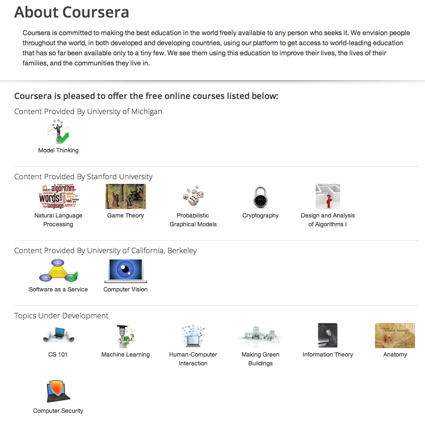
I've signed up for the free Stanford Cryptography course offered for free online through Coursera. This is one of a number of courses being offered through Coursera:
NewImage

I teach networking and wireless courses where we introduce the concepts of encryption and cryptography, but not at this level and to this depth. I felt it would inform my lectures and enrich my own understanding to participate in ("take") this course. My Masters and PhD work both required a great deal of high-level math, but it's been nearly 20 years since I've done that sort of math on a day-to-day basis. Likewise my programming skills – I used to be quite the Fortran programmer – have no doubt atrophied. In addition to my interest in the content of this course, I'm very interested in the quality of the course and the quality of the online delivery. I hope to be able to learn some new things that I can bring to my online and web-enhanced courses.

Over the next 10 weeks, I'll be posting my experiences in this online course – I encourage you to register and follow along.

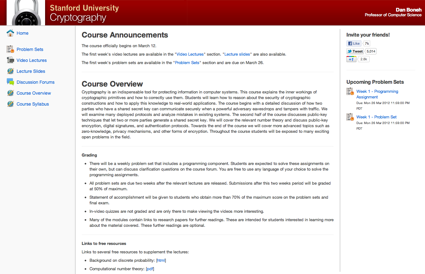
The course, taught by Dan Boneh, which begins tomorrow March 12th, consists of "Video Lectures" (along with the slides themselves), "Problem Sets" and a "Discussion Forum".
NewImage

The course is split into two modules and scheduled to run for 10 weeks:

NewImage

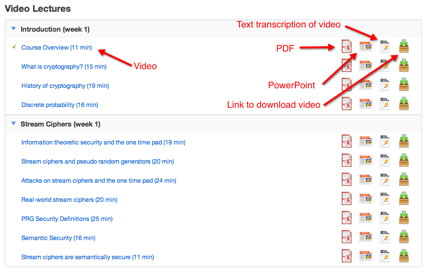
The Video Lectures, which are delivered in small bite-sized pieces, are available online and can be downloaded. The slides are available as PDF and PowerPoint, along with a text-based transcription of the video (great for ADA compliance!).
NewImage

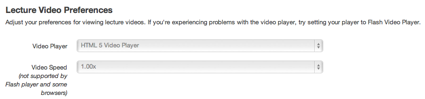
A great feature in the preferences in the ability to toggle the format of the videos – either Flash or HTML5.
NewImage

The HTML5 version looks great on an iPad – even without a Retina display:

Cryptography course


Tuesday, February 21, 2012

Free Education Online

Why should someone pay for an college education? Are our days in higher ed numbered?

Whitson Gordon gives a nice rundown of Where to Get the Best Free Education Online:

Whether you're a student looking for supplemental learning or you're in the workforce but thirsty for knowledge, you don't have to drop thousands of dollars in tuition to enjoy a top-notch education from some of the best schools in the world.

...

While most online resources won't grant you a college degree, there's a lot more to the internet than Wikipedia when it comes to learning. Whether you learn best through video or text, want to take a year-long course or just to touch up on a few topics, there are more than a few places online that can give you the full experience. In fact, there are enough that it can get quite overwhelming, so we've rounded up the best resources to make it all a bit more manageable. Here are some of the best places to get an education without ever leaving your computer.

First Stop: The OpenCourseWare Consortium

MIT began their OpenCourseWare initiative and published their first batch of courses online in 2002. In 2005, they formed the OpenCourseWare Consortium, which partnered with other universities to bring free education to the masses via the internet. Most courses offered on OpenCourseWare are available as free audio or video lectures for free, and under open licenses. The easiest way to find a course you're interested in is to search the OpenCourseWare Consortium site


...

The Khan Academy

The Khan Academy is a bit more narrow than the others; as it isn't an aggregator, it's mostly the work of one man, an electronic chalkboard, and YouTube. It focuses mostly on math, from basic arithmetic to calculus, as well as a bit of science.


...

Academic Earth

Previously mentioned Academic Earth aggregates lectures from 19 different universities on a variety of subjects. The idea is similar to that of the OpenCourseWare Consortium, although it's slightly smaller and organized differently


...

iTunes U

The last video resource is the ever-growing iTunes U (accessible through the iTunes Store at the bottom of the front page). If you're an iPod, iPhone, or iPad user, iTunes U is fantastic because you can download these lectures right to your device and take them with you.


...

WikiversityWikiversity (and its sister site, Wikibooks) is a fantastic resource for all kinds of information. Users can contribute their own projects or research to the wiki, and it hosts a ton of textbook-like resources, organized in a tree


Textbook Revolution

We've also mentioned Textbook Revolution before, and it deserves a little more attention. Textbook Revolution's goal is to bring together as many free textbooks on the net as they can.


Straight from Universities

It's also worth noting that a few other universities offer online textbooks, such as Carnegie Mellon's Open Learning Initiative and the Supplemental Resources section of MIT's aforementioned OpenCourseWare (in fact, while OpenCourseWare focuses on video, they have a ton of other resources like online textbooks, lecture notes, and assignments for many of their classes

Wednesday, January 11, 2012

Saturday, December 17, 2011

Feedback on Stanford Online Classes

Hernan Amiune is not so happy with Stanford's online classes - at least the end result.

NewImage

Stanford Online Classes. Like A Great Movie With A Bad Ending:

Professors are AWESOME!
The exercises are AWESOME!
The classes are AWESOME!

But then they send you the Statement of Accomplishment. This was obviously done by engineers with no knowledge of public relations or marketing. And maybe under the pressure of Stanford (lawyers?) to clarify that this wasn't a Stanford class.

Before the course started they promised the Statement of Accomplishment as an incentive to get you in the course.
When they got a lot of users they said “You will receive a statement of accomplishment from the instructor, which will include information on how well you did and how your performance compared to other online students. Only students admitted to Stanford and enrolled in the regular course can receive credit or a grade, so this is not a Stanford certificate.”
At the end they send you a pdf file that says something like this:hey you didn’t complete any Stanford course, you were just part of an experiment and this is an automated message.

It’s a pity because the courses were so great, so tasty, but this leaves you with some bad taste in your mouth. And I think that not sending any Statement of Accomplishment would have been much better.


Tuesday, December 13, 2011

Three-Week Online Courses

Anthony Stoeckert reporting … Alvin Community College to offer three-week online courses:

Alvin Community College is offering students a chance to get a headstart on the spring semester with online courses beginning Dec. 19.

Courses being offered include Composition I and II, American National and State Government I and II, U.S. History to 1877, U.S. History since 1877, Texas History, Developmental Math - Intermediate Algebra, College Algebra, Fitness and Wellness, Introduction to Philosophy, General Psychology, Introductory Sociology and Interpersonal Communication, according to a press release.

Monday, December 12, 2011

Isaac Newton’s Personal Notebooks Go Digital

Cambridge's site is a little uncooperative, but this is a very cool project.

Shared by Brandon Keim – Isaac Newton’s Personal Notebooks Go Digital:

The largest collection of Isaac Newton's papers has gone digital, committing to open-access posterity the works of one of history's greatest scientist.

Among the works shared online by the Cambridge Digital Library are Newton's own annotated copy of Principia Mathematica and the 'Waste Book,' the notebook in which a young Newton worked out the principles of calculus.

Other of his myriad accomplishments include the laws of gravity and motion, a theory of light -- pictured above are notes on optics -- and his construction of the first reflecting telescope.

Sunday, December 04, 2011

CyberMonday and the Digital Divide

From Susan P. Crawford – Internet Access and the New Divide:

FOR the second year in a row, the Monday after Thanksgiving — so-called Cyber Monday, when online retailers offer discounts to lure holiday shoppers — was the biggest sales day of the year, totaling some $1.25 billion and overwhelming the sales figures racked up by brick-and-mortar stores three days before, on Black Friday, the former perennial record-holder.

Such numbers may seem proof that America is, indeed, online. But they mask an emerging division, one that has worrisome implications for our economy and society. Increasingly, we are a country in which only the urban and suburban well-off have truly high-speed Internet access, while the rest — the poor and the working class — either cannot afford access or use restricted wireless access as their only connection to the Internet. As our jobs, entertainment, politics and even health care move online, millions are at risk of being left behind.


Saturday, May 28, 2011

Re-Thinking Your Next CV

The CV or curriculum vitae is the academics version of a resume. Whether you're in academia, industry, or looking for your first job, this presentation provides some good advice for building an online CV or an online presence. My favorite pieces:
  • A blog to share your thoughts
  • Linkedin to connect
  • Facebook to engage
  • And connect them!
Other important points:
  • Design the CV - i.e. give it some thought, don't just throw it together
  • You can still you "old" media
  • Include a video - great advice!
  • Show off your skills!

Monday, February 28, 2011

10 Petabytes Visualized

Online storage service just passed the 10 petabyte mark. Interesting visualization - that's a lot of data!
10 petabytes - visualized:
While l see us constantly adding storage for our online backup service, it was one of those moments that made me think, “Wow, that’s a lot of storage.” Ten petabytes is roughly double the entire archive of the Internet.
We tried to visualize what 10 petabytes of storage looks like. Here are three takes on it:
#1: 10 Petabytes in Backblaze Storage Pods
10 petabytes 1
#2: 10 Petabytes in Pixels by Drive Size Used
10 petabytes 2
#3: 10 Petabytes of Drives Stacked Vertically (my favorite)

10 petabytes 3


Tuesday, February 22, 2011

Disrupting College

Everyone should read Clayton Christensen's
Disrupting College: How Disruptive Innovation Can Deliver Quality and Affordability to Postsecondary Education.
Download the full report (pdf)
Download the executive sumary (pdf)
Download the report to mobile devices and e-readers from Scribd

Disrupting College:
America is in crisis. Employers say paradoxically they cannot find the right people to fill jobs even though the country is facing its highest unemployment rates in a generation. Competition with a rising China and India and their vast populations lend urgency to the need for the country as a whole to do a better job of educating its citizens.

The institutions to which the country would turn to help tackle this challenge—its colleges and universities—are facing a crisis of their own. There is a rising chorus of doubts about how much the institutions of higher education that have been such a part of the country’s past successes can be a part of the answer. Graduation rates have stagnated despite a long track record of serving increasing numbers of students over the past half century. None of America’s higher education institutions have ever served a large percentage of our citizens—many from low-income, African-American, and Hispanic families. The institutions are now increasingly beset by financial difficulties, and the recent financial meltdown is but a shadow of what is to come. The further looming state budget crises spell difficult times for many colleges and universities. And there is a growing acknowledgement that many American universities’ prestige came not from being the best at educating, but from being the best at research and from being selective and accepting the best and brightest—which all institutions have mimicked.

Our country’s dominant higher education policies have focused on expanding access for more than half a century—allowing more students to afford higher education. Yet changing circumstances mandate that we shift the focus of higher education policy away from how to enable more students to afford higher education to how we can make a quality postsecondary education affordable.

Tuesday, February 01, 2011

Recommendations for Online Learning

Why do students choose online learning? The highlighted portion below says it all:
  • flexible,
  • accessible,
  • work-based skills,
  • can fit around family commitments
Interesting recommendations as well. Use technology to enhance student choice - what could that mean? Maybe the ability to begin and finish a course on their own timetable; maybe more classes available online. And the others? Investment, partnerships, scaling, branding - sounds a lot like terms you might hear a business throw around. If we're serious about online education and want to compete the the University of Phoenix's of the world, maybe we need to approach online learning as a business.

British Report Calls for Greater Use of Online Learning to Meet Growing Demand:
The report says that courses offered by those programs are "flexible, accessible, provide practical work-based skills, and can fit around work and family commitments which prevent students from attending a traditionally delivered course."

The report outlines six recommendations for future success, including the use of technology that enhances student choice, greater investment to enable the development of partnerships to achieve "scale and brand in online learning," and the acquisition of "more and better market intelligence about international demand and competition."

Saturday, January 29, 2011

Is Microsoft Irrelevant?

I think they are in mobile and online - see the two stories below.

For the First Time in My 20 Year Career, Microsoft is Irrelevant:

for the first time in my career Microsoft is just plain not in the game.  Irrelevant.  No show.

Now, I’ve been at this game awhile.  I wrote my first code in 9th grade in 1979 (on a TRS-80 Model 1) well before Microsoft mattered.  But my first real development came during the period when Microsoft was trying to get Windows to be real.  In those days Digital Research had a great DOS called DRDOS that was the cats meow.  And in my opinion, Microsoft did everything in their power to make sure DRDOS failed.  Fast forward through all the history with Microsoft, the anti-trust cases, the clear outright dominance of the market, the flailing attempt of my beloved Linux to get some kind of toe-hold, the Microsoft funded SCO debacle… for most of my professional life Microsoft has been the bruiser, the 600 pound gorilla, the Heavyweight Champion of the World.

Not any more.  When was the last time you heard something about Microsoft that mattered?  Thought so.

The reality is that in the consumer space it’s now Apple and Microsoft.  The shift to mobile-oriented computing is well documented (I won’t elaborate here).  For most people the computer they use most is their mobile phone.  The innovation and the new markets are in mobile.  The interaction with the cloud will be primarily mobile.  In short, the MARKET that MATTERS will be mobile.  And Microsoft has a pathetic attempt with Windows Mobile 7.  It’s late, it’s not as good as what shipped by Apple or Google/Android last year, and it has no compelling EXTRA VALUE.

Microsoft’s Online Efforts Keep Losing Money:

Microsoft reported good results yesterday for the last quarter of 2010. I guess the term good could be an understatement when you post a quarterly profit of $6.63 billion on numbers that beat the street. No one doubts that Microsoft is still a strong company with Windows, Office 2010, Xbox, Kinect and server businesses moving right along.

However, what we are interested in the Internet side of the ledger and it tells a familiar story that makes one wonder if Microsoft will ever make money online.

Microsoft-Online-Operating-Income1.jpg

Wednesday, January 12, 2011

The End of the Music CD

Not surprising, although unfortunate for the 300 people who will lose their jobs.

Is the DVD next? Sony closing CD plant in face of digital music:
Sony will close one of its biggest CD making factories due to the growth and popularity of digital downloads as well as other economic influences. Based in Pitman, New Jersey, the plant has been operating for 50 years and first produced vinyl records. When its doors close on March 31, nearly 300 people will be out of work.

Tuesday, November 30, 2010

Wednesday, March 31, 2010

Is the Institution Irrelevant?

Karl Kapp left an interesting comment on my post "If You Don't Want Our Department, ...":

Mike,
This is very interesting, as technology increases an individual's ability to reach more and more people at a cost effective level, the influence and power of education is moving away from institutions and toward individuals...in this case an individual department. I see this trend increasing.

If institutions don't start to value their faculty...faculty will begin teaching independently.


I agree with Karl, this does demonstrate that education is shifting away from the institution to the individual - in this case the faculty. I would go further and say that trends such as MIT's OpenCourseWare initiative portend a future where the institution is even less relevant and even disintermediated, resulting in a direct link between faculty and students.

The situation in Florida probably happened because the circumstances where perfect - while one school was shutting down their program, a nearby school was starting a new program with a new building and the resources to bring faculty in support of the program. The proximity of the schools contributed as well, the faculty did not have to relocate, the faculty and their reputations were probably known to the new institution. I'm sure this is just the beginning of this trend, but I think there's real potential for online institutions (U of Phoenix, Capella U, etc) to cherry-pick individual faculty and even gobble up entire departments. Even bricks-and-mortar institutions with growing online programs could get into the act.

Thanks Karl!

LinkWithin

Related Posts Plugin for WordPress, Blogger...