Showing posts with label Kindle. Show all posts

Wednesday, October 17, 2012

With Whispercast, Amazon Hoping to Get Kindles into Schools and Businesses

Pretty savvy move … Amazon looks to get Kindles to schools, workers:

Amazon.com has launched a service to help schools and workplaces manage Kindles used by students and employees — sending out e-books or blocking certain types of activities, for example.

Called Whispercast, the free service lets businesses and schools buy and distribute books and documents to Kindles over a wireless Internet connection. This means teachers can send out books to students in their class, and businesses can send out training materials, schedules and other documents, Amazon said. Schools can also block Kindles from accessing the Web and can prevent students from being able to make purchases on the device.

Amazon said the service lets administrators register students and employees to their organizations' Kindle devices, assigning them into groups for classes, grade levels or corporate departments. They can then distribute content to these groups or configure the settings on the devices from one location.

Friday, September 07, 2012

Should I Pre-Order a Kindle Fire HD?

Jay Yarow's advice – Do Not Pre-Order Any Of The Amazon Kindle Fire HD Tablets:

at just $199 for the 7-inch model and $299 for the 9-inch model, it's tempting to hop over to Amazon.com and pre-order the tablets.

Our advice: Don't do it.

Last year Amazon announced the Kindle Fire and it looked great. We, like many others, pre-ordered the tablet before anyone really got time to play with the tablet. When it finally arrived it was a let down.

This year, we highly recommend waiting until reviewers get some time to actually use the Kindle Fire HD tablets for extended periods of time.

Thursday, August 16, 2012

State Department Changes Mind on Kindle

That's a lot - excuse me, was a lot of Kindles.

From Evan Rodgers – State Department withdraws $16.5m contract for Kindle ebook readers:

The US State Department's $16.5 million contract with Amazon for Kindle ebook readers has been officially canceled. The details of the contract were proposed back in June and would have netted the State Department 2,500 Kindles for use in overseas English language programs. The docket has since been revised, saying that "the Department of State intends to conduct additional market research and re-examine its requirements for this program." The Kindle was originally picked over other ebook readers for its compliance with the State Department's long list of requirements. Whether Amazon has backed out of meeting these stringent and likely expensive requirements — like item 19, which states "the Contractor is responsible for all costs associated with 3G services globally" — has yet to be determined.

Friday, June 15, 2012

Amazon E-Books Not Such a Great Deal …

… for authors.

Andrew Hyde analyzes that sales data for his travel e-book. Really shocking – I had no idea! Amazon’s Markup of Digital Delivery to Indie Authors Is Around 129,000 Percent:

So my book about travel came out last week! You should buy it! A pretty exciting time.  I’ve decided to write a few posts covering the launch and lessons I’ve learned.I self published it (wrote, designed, marketed and even did the layout for it) and am really proud of the project.

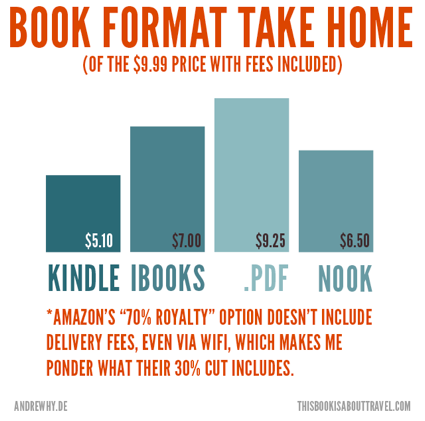
This post is about the where the sales of the book are coming from, and why Amazon takes 48% of digital book sales.  Surprising eh?  I thought Amazon was the BEST for indie authors, right?

NewImage

Wait, Amazon pays out the worst? What? This can’t be right! They are the best right? Everyone loves them. I love them. I dig a bit deeper and find this little gem:

Avg. Delivery Cost ($) 2.58.

So for every $9.99 book I sell I, the author, pay 30% to Amazon for the right to sell on Amazon AND $2.58 for them to deliver the DIGITAL GOOD to your device. It is free for the reader, but the author, not amazon, pays for delivery.[emphasis added – MQ]

The file itself is under their suggested 50MB cap Amazon says to keep it under at 18.1MB. The book contains upwards of 50 pictures and the one file for Kindle needs to be able to be read on their smallest displays in black and white and their full color large screen Mac app). I’m confused. Amazon stores a ton of the Internet on S3/EC2, they should have the storage and delivery down. If I stored that file on S3/EC2 it would cost me $.01 PER FIVE DOWNLOADS. Hat tip to Robby for that one. Use Amazon to run your website: .01 to download a file. Use amazon to sell your book: $2.58 per download + 30% of whatever you sell.

(Via Daring Fireball)

Friday, May 11, 2012

The Future of Paper Books

Michael Agresta wonders What Will Become of the Paper Book? Spoiler – he does see a future for print.

The change has come more slowly to books than it came to music or to business correspondence, but by now it feels inevitable. The digital era is upon us. The Twilights and Freedoms of 2025 will be consumed primarily as e-books. In many ways, this is good news. Books will become cheaper and more easily accessible. Hypertext, embedded video, and other undreamt-of technologies will give rise to new poetic, rhetorical, and narrative possibilities. But a literary culture that has defined itself through paper books for centuries will surely feel the loss as they pass away.

Luddites can take comfort in the persistence of vinyl records, postcards, and photographic film. The paper book will likewise survive, but its place in the culture will change significantly. As it loses its traditional value as an efficient vessel for text, the paper book’s other qualities—from its role in literary history to its inimitable design possibilities to its potential for physical beauty—will take on more importance. The future is yet to be written, but a few possibilities for the fate of the paper book are already on display on bookshelves near you.


Photo by Paul Lowry - http://flic.kr/p/4sgQpY

Thursday, May 03, 2012

Kindle Fire Takes a Nosedive

From Eric Slivka … Apple's Share of Tablet Market Surges to 68% as Kindle Fire Shipments Plummet:

IDC today released its data on worldwide tablet shipments for the first quarter of 2012, revealing that despite a quarterly drop in iPad shipments of over 20%, Apple's share of the tablet market rose to 68% from last quarter's 54.7%. Apple's boost came at the expense of Android-based tablets, most notably Amazon's Kindle Fire which appears to have seen its shipments collapse from 4.8 million units in the fourth quarter of 2011 to less than 750,000 units last quarter.


Thursday, January 12, 2012

Amazon Kindle Lending Library a Hit

This is a great benefit for Amazon Prime members, unfortunately the Lending Library is limited to Kindle devices – not Kindle apps on other devices (iPad, iPhone, laptop, etc).

Leena Rao reporting … Amazon Kindle Owners Are “Borrowing” Nearly 300,000 Electronic Books A Month:

Amazon is releasing new data on its Kindle Lending Library, which the e-commerce site says now has over 75,000 books. The Kindle Owners’ Lending Library is a collection of books that Amazon Prime members who own a kindle can borrow once a month, with no due dates.

Amazon recently launched KDP Select, a fund that lets indie authors and publishers make money off of lending. Basically, if a KDP author or publisher chooses to make any of their books exclusive to the Kindle Store for at least 90 days, those books are eligible to be included in the Kindle Owners’ Lending Library and can earn a share of the KDP Select fund.

According to the company, customers borrowed nearly 300,000 (295,000 to be exact) KDP Select titles in December alone, and KDP Select has helped grow the total library selection. With the $500,000 December fund, KDP authors have earned $1.70 per borrow. In response to strong customer adoption of the Kindle Owners’ Lending Library, Amazon says it has added a $200,000 bonus to the January KDP Select fund, raising the total pool from $500,000 to $700,000 for authors.

The top ten KDP Select authors earned over $70,000 in the month of December from their participation in the Kindle Owners’ Lending Library, which is a 30% increase on top of the royalties they earned from their paid sales on the same titles in the same period. In total (paid sales plus their share of the loan fund), these authors saw their royalties grow an astonishing 449% month-over-month from November to December. The list of top 10 KDP Select authors includes Carolyn McCray, Rachel Yu, the Grabarchuk family and Amber Scott.

Wednesday, November 16, 2011

Publishers Not Happy With Kindle Lending Library?

From Nate Anderson

Kindle lending library "exercise of brute economic power," says Guild:

After seeing that a movie adaptation was in production, last week I downloaded Suzanne Collins' novel The Hunger Games—and I didn't pay a thing for it. But I didn't turn to piracy. Instead I visited Amazon.com, where the company's new "Kindle lending library" offers those with Kindle hardware and an Amazon Prime subscription one free book to read each month. It's a terrific new benefit for Prime users, and it's clearly designed to hook people on Amazon hardware (like the new Fire tablet) and digital content.

Amazon attracts more customers to e-books, readers get free content, and publishers get paid. Everyone's happy, right?

Wrong. The Authors Guild, which represents the interests of writers, blasted the program yesterday, saying that the lending library program is built on "nonsense" and a "tortured reading" of Amazon's contracts with publishers.

"Amazon, in other words, appears to be boldly breaching its contracts with these publishers," wrote the Guild. "This is an exercise of brute economic power."

Monday, November 07, 2011

Microsoft and Tablets

From Matt Rosoff - SCOBLE: Microsoft Can't Win In Tablets (MSFT):

Robert Scoble offers a pretty solid argument against Microsoft succeeding in the tablet space.

In a recording posted to FlipZu, he offers two main reasons why Microsoft will fail.

First, he says that upcoming tablets running Windows 8 are being squeezed between low-cost tablets from Amazon and the $500 iPad with its well-established ecosystem.

On the low end, Amazon and Barnes & Noble can sell tablets as a loss-leader that get users to buy more digital content. Microsoft can't compete there because it simply sells the operating system and its hardware partners won't be willing to match Amazon's price because they have no services on which to make money.

On the high end, by the time Windows 8 tablets come out in late 2012, the iPad will have been on the market for more than 2 years, and will have an enormous head start in terms of apps and hardware peripherals.

Worse yet, he argues, Microsoft and its partners won't have time to redesign Office and other applications to work with the new Windows 8 interface. So customers will see tablets with a great touch interface on top and garbage underneath.

"It really looks beautiful on top, but you start touching it and go deeper and it looks crap inside," he said.

He also thinks that having Office won't help: "Microsoft had tablets for many, many years. And Microsoft Office had always run on them. That was not a selling case for these things. And if you think it is, you're stupid."

Thursday, November 03, 2011

Kindle Owners’ Lending Library

John Gruber read the fine print on Kindle's new Lending Library

Kindle Owners’ Lending Library:

You need to own an actual Kindle, though, not just use the Kindle app on another device. And, publishers need to opt-in, and none — zero — of the big six have.

Amazon Adds Free Kindle Books for Prime Members

From Richard Lawler Amazon Prime adds new reading option with Kindle Owners Lending Library:
Amazon's home page has a new message for Prime members from CEO Jeff Bezos, indicating that their membership plan has a new bonus: free books. The Kindle Owners Lending Library service offers up to one book per month from a selection of thousands of titles, including "over 100 current and former New York Times Bestsellers" with no due dates. Check out the press release after the break for a few more details.

Friday, October 28, 2011

Where Should I Buy My E-Books?

Marco Arment does an Informal e-reader library comparison

Since the iPad first launched, I've found greater availability and lower cost for Amazon versus iBooks e-books, maybe that's beginning to change.

In the past, I’ve always recommended the Kindle over other e-ink readers, and buying Kindle books instead of iBooks on iOS, because Amazon had the biggest library of relevant titles and strongest content ecosystem.

But Amazon’s advantage is no longer as clear in my casual searching.


- Posted using BlogPress from my iPad

Thursday, October 20, 2011

Amazon Shifts Kindle to HTML5-Powered File Format

Disappointed they didn't include the HTML5 audio or video tags.
From Devin Coldewey –  Amazon Throws A Minor Curveball With HTML5-Powered Kindle Format 8:
Amazon has announced an update to the Kindle file format integrating many HTML5 tags and CSS attributes. Many expected a concession by Amazon in the form of an EPUB-compatible upgrade, and this comes as a slight surprise — but it’s a natural evolution of the format, really, and of course everyone is already familiar with the toolset.
In a way this makes Kindle formatted books nothing more than extremely long webpages, but that’s really a matter of perspective. Flexible layouts and well-known rules for handling text, fonts, images, and so on mean that the file format is adaptable to many devices, zoom levels, resolutions, and so on.
The full list of new tags and such can be found here; there’s no video or audio tag, tellingly, but apart from that it seems a fairly normal collection of HTML elements and CSS stuff.

Wednesday, September 28, 2011

Kindle Fire First Impressions

Dan Frommer at SplatF - Kindle Fire: No big threat to the iPad, but should sell well:
Bottom line: The Kindle Fire isn’t much of an iPad threat yet. The real trouble will be for companies like Barnes & Noble, RIM, and Samsung, which are trying to sell 7-inch tablets that either cost considerably more or have poorer content and apps ecosystems.

I think the price point is going to attract a lot of buyers. Amazon has been very careful to position this device as a Kindle, rather than a table - NOT an iPad competitor. For some, this will take the place of a tablet, but for the vast majority of buyers, I think this will serve as a companion device to their existing iPad.

Tuesday, September 27, 2011

Amazon's Tablet

I hope this report is off the mark. It would be a shame for Amazon to launch a dud after all this hype. As much as I love the iPad, the tablet-space needs competition to drive innovation forward.

Amazon's Tablet Is A "Pretty Poor" "Stopgap" That The Kindle Team Didn't Even Work On

Just before Amazon officially reveals its tablet, Ryan Block at GDGT has a report on what we can expect, and it does not sound good.


- Posted using BlogPress from my iPhone

Friday, May 27, 2011

An E-Book Convert

A Book Lover Switches To The Kindle

While I love physical books, the benefits of ebooks trump the physical:
  • Bring my entire library anywhere.
  • Easier access to highlighted content and notes.
  • Impossible to lose the book.
  • It doesn’t require a bookshelf. Having moved about once a year in the last four years, I find my large book and especially DVD collection a burden.
  • Easier access to, ahem, bathroom reading material. Pulling up a book on my iPod touch is simple and enjoyable in short bursts.


- Posted using BlogPress from my iPad

Wednesday, May 25, 2011

Touchscreens and E-readers

Most have responded positively to the release of touchscreen e-readers from Kobo and Barnes and Noble. Here's a dissenting view from Matt Burns. I doubt that Burns has actually used a touchscreen e-reader and I think he underestimates the benefits that a touchscreen would provide to reading. To most, I think the benefits of a touchscreen far outweigh any negatives.

Amazon, Please Do Not Make The Kindle Touchscreen

The beauty of e-ink screens is text looks fantastic. It looks just like text — or it’s the closest thing to paper print as technology gave us yet and the latest Pearl screen is awesome. But I don’t want to touch it. I don’t want to wipe my screen or worry in any fashion about the screen. True, e-ink screens aren’t LCD screens. They don’t have a glossy overlay that naturally sucks the oil out of my fat fingers. E-ink screens are generally finger-friendly. Still, why do I want to control the device with the screen?

In many ways this is BlackBerry versus iPhone. Touchscreen versus keypad. But it’s not the QWERTY keypad that I necessarily I care about. It’s the thought processes involved that are naturally inherent with touchscreens. They need to be cared for differently. Suddenly a screen protector is a must-have accessory. You’re going to be touching and prodding it after all.


- Posted using BlogPress from my iPad

Friday, May 20, 2011

E-Books and Amazon

Nik Gregory provides some insightful analysis of the recent news that Amazon's Kindle e-book sales have surpassed print books.

Of Amazon and eBooks, again

a full and comprehensive book pricing breakdown; what you need to know: 10% of cover price covers printing, 10% goes to the distributor and a whopping 40% is taken by the retailer, which is why Walmart manages to sell big titles at 30% and sometimes even 37% off and still make money.

Now onto the news. Amazon’s present claim is grossly misleading, eBook sales still only attribute to around 9% of the total publishing market. Total Book sales for January 2011 was at $805.7 million, and eBooks were only $69.9 million of that.

What’s actually going on?

Mass Market Paperbacks and Trade Paperback sales have been losing ground, notably Mass Markets as this is the key area where eBooks are cannibalizing the market. Why? Because eBooks are the new mass market books. They have virtually zero expenses for editorial work as this has already been done in more expensive editions. They’re released cheap and you’ll likely see the ebook copy only about 10% less than the paperback. Why? As I said, 10% of the cover price goes to printing. The 10% for distribution is still in the midst with Amazon charging kickbacks to the seller.

Hardbacks quite interestingly are still going strong, they have yet to see a true loss in sales. This may be because publishers are recognizing them for what they truly are – luxury items. They’re coming in limited editions, and I don’t doubt it’ll be long before they’re coming in boxed sets with extras and short stories, author commentary and such attached to justify a $50 cover price.

What is truly great news for the publishing industry is this: Mass Market and Trade paperback sales aren’t just disappearing into eBooks. It appears that on the whole, a portion of eBook sales are complimenting the industry, meaning eBooks might actually be increasing the amount of money people are spending on reading (which will mean in about a decade we might have some awesome book->movie adaptations going again).


- Posted using BlogPress from my iPad

Thursday, May 05, 2011

Kids Don't Want Kindles - They Want iPads

A nice companion piece to my post Students Not So Hot on Kindle, where I pointed out:
A stunning 60% stopped using the devices. Maybe a more generic devices - like a tablet - would be more integrated into their lives than a single purpose Kindle. That could be an iPad, an android tablet or even the Nook e-reader or rumored Amazon tablet.
Shocker! College kids like having iPads in the classroom:
E-readers may not be good enough for Princeton's hallowed halls, but students and professors at Oklahoma State University seem to have fallen head over heels for their iPads. Last fall, the school introduced the tablets in a handful of lecture halls and classrooms, as part of its iPad Pilot Program. Teachers involved in the study said they benefited from all the educational software available on Apple's App Store, while students appreciated not having to spend their life savings on traditional textbooks. At the end of the pilot program, a full 75-percent of collegians said the iPad "greatly enhanced" their classroom experience
...
Opinion was noticeably more divided, however, on the device's value as an e-reader. Some enjoyed having all their books in one place, whereas others were a bit disappointed with the experience, saying they didn't use it to read as often as they expected to.

Wednesday, May 04, 2011

Students Not So Hot on Kindle

A stunning 60% stopped using the devices. Maybe a more generic devices - like a tablet - would be more integrated into their lives than a single purpose Kindle. That could be an iPad, an android tablet or even the Nook e-reader or rumored Amazon tablet.

Mixed Reviews in Study of Kindle Use

A study of student use of the Kindle DX at the University of Washington gave the device decidedly mixed reviews, The Seattle Times reported. The study involved first-year graduate students in computer science and engineering -- students who are presumably comfortable with digital information. But seven months into the study, 60 percent of the students had stopped regularly using their Kindles for academic reading. Although the Kindle has note-taking capability, the study found many students preferred to use paper to take notes on what they read on their Kindles.


- Posted using BlogPress from my iPhone

LinkWithin

Related Posts Plugin for WordPress, Blogger...