Several people have asked why I switched from the iPhone to a G1 running Android. My reasons are both practical and philosophical.
The practical ones:
- I’m a heavy Gmail user, and Android’s Gmail interface far surpasses the options on the iPhone. Reading, searching, labeling, and otherwise processing my email is the most important thing I need to do on my smartphone besides make calls, and it’s simply easier in Android.
- Android lets me manage my contacts in one place: Gmail, and syncs them automatically to my phone. No more local address book!
- Android is better than the iPhone software in a few ways: it’s way more customizable, it offers copy and paste, the pull-down ‘window shade’ is a better notification mechanism, and in general it gives you that feeling that you’re in control of every setting.
- Android doesn’t run Safari, but it will likely run Chrome someday.
- I love the trackball on the G1 for scrolling and clicking. From an economy-of-motion standpoint, it’s a way more efficient way to interact with the device than swiping and tapping the screen. The snap-out keyboard is sweet, too.
The philosophical reasons:
- Android is open source.
- Because it’s open source, many of my favorite open source apps work with it and not the iPhone yet, like KeePass, for example. (See KeePassDroid.)
- Android’s apps are written in Java, and as a Java developer, this delights me.
- Android doesn’t tie me to iTunes, which is a fine piece of software, but is just a little too bossy and proprietary-like for my taste.
Obviously, your mileage may vary. But there is a misconception that the iPhone is a superior smartphone, and that’s not necessarily true. What’s true: The iPhone software has been out longer than Android, so it may be more fully-baked (though apps and Safari crash on my iPhone regularly, more so in the 2.0 ‘upgrade’). The iPhone has a much larger market share. There are probably more apps for the iPhone than for Android, but the Android Market is well-stocked, and I have had little trouble finding the stuff I need. The only iPhone thing I truly miss is its built-in visual voicemail, but I’ve installed PF Voicemail+ on Android to get that same functionality. Not being a heavy voicemail user, this isn’t that big of a deal to me (though it may be for you). Update: I also miss the excellent Evernote iPhone app, and have my fingers crossed in hope an Evernote equivalent will happen soon (or at least a mobile Evernote site that works well in a mobile browser).
Most likely I’ll remain in the minority as a G1 owner, but you know what? In a sea of iPhone-toters, I’ll enjoy actually ‘thinking different.’
Monday, February 09, 2009
Why I Switched to Android from the iPhone | Smarterware
I'm a big fan of Gina Trapani and a constant reader of her Lifehacker blog. She's taking a break from posting on Lifehacker.com and has started a new blog Smarterware. Here's a great post where she describes her reasons for switching from the iPhone the the Google Android. Why I Switched to Android from the iPhone


Students: Business versus Engineering
From the Engineering and Technology Dean's (ETD) listserv that I subscribe to:
In an interview in yesterday's NY Times Magazine, there was the following question and answer from ex-banker Felix Rohatyn:
Question: Are you concerned about the number of students who have forsaken engineering for business school?
Answer: They’ll go back to being engineers after they’ve discovered that business school doesn’t make them millions of dollars. They’ll see the stock market doesn’t do them much good, so they might as well do something constructive.
You can read the whole interview (which is not otherwise about engineering) at:
http://www.nytimes.com/2009/02/08/magazine/08wwln-Q4-t.html?_r=1&scp=1&sq=questions%20for%20felix&st=cse
What’s New With The Kindle 2
I'm sure there will be a lot of reviews of the new Amazon Kindle 2, with plenty of video. Here's a quick summary of what's new from TechCrunch What’s New With The Kindle 2:
So just what’s new and different? We’ll take you through the highlights below.
- The new Kindle is slightly lighter. The first generation weighed 10.3 ounces while the second weighs only 10.2 ounces
- It’s much less ugly. Gone is the retro look of the first generation for a curvier and more symmetrical design that (like every other mobile device hitting the market these days) borrows elements from the iPhone
- The screen has a higher wow factor At six inches tall, it can display 16 shades of gray, and it can turn pages
20 times20% faster (or so Amazon claims)
- It can actually speak to you Amazon’s new Text-to-Speech feature will use a computerized voice to read any book to you in one of three speech rates, and in either a male or female voice
- The new controls are better designed. Instead of a weird slider on the right-hand side that’s used to move from line to line, there’s a new 5-way joystick. The keyboard is also no longer split into two regions like those funky desktop keyboards you see at Fry’s but never buy.
- There’s been no price drop It still costs roughly the same amount ($359) but at least there’s still no monthly wireless fee for downloading books, magazines, etc.
- It can hold a much bigger library Storage has been boosted to 7x the original size, allowing the device to carry over 1,500 titles at a time
- It downloads content just as fast. Amazon is touting 60 second downloads for books, etc. — the same rate it gave for the first Kindle
- You can pick up your reading on a separate Kindle. I’m not sure how useful this will actually be for people, but a new feature called ‘Whispersync bookmarking’ makes it possible to start reading a book on one Kindle then continue reading it on another, just where you left off
- It still comes in only one color. White
TED 2009
Anyone who reads this blog on a regular basis - all eight of you ;) - knows what a big fan I am of the annual TED conference. Held every spring, TED is a great opportunity to see bite-sized presentations and demonstrations showcasing new ideas and new technologies. In fact, it was a TED video where I first saw Jeff Hahn demoing his multi-touch re-purposed drafting board. Now multi-touch is mainstream.
Unfortunately, TED is by invitation only, so you and I will never get to be there live. The solution has been to watch video of the event after the fact - until this year. This year, the producers of TED have created a free iphone app to allow users to read stories, listen to audio, and watch video from the conference. A great step forward!
If you're hosting or organizing a conference, you should seriously consider creating an iPhone app to connect with your attendees and those unable to attend. With travel budgets getting cut everywhere, the ability to connect with the community is even more important!

-- Posted from my iPhone
Unfortunately, TED is by invitation only, so you and I will never get to be there live. The solution has been to watch video of the event after the fact - until this year. This year, the producers of TED have created a free iphone app to allow users to read stories, listen to audio, and watch video from the conference. A great step forward!
If you're hosting or organizing a conference, you should seriously consider creating an iPhone app to connect with your attendees and those unable to attend. With travel budgets getting cut everywhere, the ability to connect with the community is even more important!
-- Posted from my iPhone
Do You Make Money from the Internet?

If you think the chart is wrong, consider the story of Dan Lyons - the journalist who wrote the viral blog - The Secret Diary of Steve Jobs, but never made enough to quit his day job. Growing Rich by Blogging Is a High-Tech Fairy Tale | Newsweek Daniel Lyons | Techtonic Shifts | Newsweek.com:
 If you think the chart is wrong, consider the story of Dan Lyons - the journalist who wrote the viral blog - The Secret Diary of Steve Jobs, but never made enough to quit his day job.
For two years I was obsessed with trying to turn a blog into a business. I posted 10 or 20 items a day to my site, The Secret Diary of Steve Jobs, rarely taking a break. I blogged from cabs, using my BlackBerry. I blogged in the middle of the night, having awakened with an idea. I rationalized this insane behavior by telling myself that at the end of this rainbow I would find a huge pot of gold. But reality kept interfering with this fantasy. My first epiphany occurred in August 2007, when The New York Times ran a story revealing my identity, which until then I'd kept secret. On that day more than 500,000 people hit my site—by far the biggest day I'd ever had—and through Google's AdSense program I earned about a hundred bucks. Over the course of that entire month, in which my site was visited by 1.5 million people, I earned a whopping total of $1,039.81. Soon after this I struck an advertising deal that paid better wages. But I never made enough to quit my day job.
Sunday, February 08, 2009
How Do We Measure the Quality of a College or University?
That's an interesting question. Clearly there are lot's of metrics we use to gauge the performance of institutions of higher ed. As this Kevin Carey post inThe Quick and the Ed blog points out, one of the most common measures of quality is the SAT scores of incoming freshmen - a criterion that wouldn't even apply to open-enrollment colleges such as mine. The post elaborates on the flaws inherent in the SAT metric - most glaringly, how does a college get credit for a test score from a students junior year in high school? So the question becomes - "How do you actually measure the performance of a college?" Although not a definitive answer, Carey argues that perhaps growth, as measured by freshmen versus senior differentials on standardized tests, such as the Collegiate Learning Assessment, would serve as a better indicator of a college's performance.
It's interesting that I see this same dynamic in my classroom. Of course there are the students that will ace every assignment, quiz and test - the perennial A-students. For other students, one of the indicators I am always looking for is growth - students who may not have started with the best test scores, but keep working hard and show that growth or improvement over the course of the semester. Sometimes it is working with these students that provides a faculty member with the greatest satisfaction.

It's interesting that I see this same dynamic in my classroom. Of course there are the students that will ace every assignment, quiz and test - the perennial A-students. For other students, one of the indicators I am always looking for is growth - students who may not have started with the best test scores, but keep working hard and show that growth or improvement over the course of the semester. Sometimes it is working with these students that provides a faculty member with the greatest satisfaction.
Colleges and universities distinguish themselves from one another in lots of different ways-- scholarly reknown, the size of the endowment, success on the athletic fields, etc. But the most commonly-used measure is probably the 'quality' of the freshman class, as measured by standardized tests like the SAT and ACT. Average incoming SAT scores at University of Texas campuses, for example, look like this:
The Austin and Dallas campuses are getting students at 1200 and above while the non-selective regional campuses like Pan American and Permian Basin are below 1000. This conforms with nearly any measure of prestige and status one could name: Austin is an internationally known, Research I, AAU institution with a multi-billion dollar endowment and a football team that was lucky enough to beat my Ohio State Buckeyes in the Fiesta Bowl last month, not that I'm bitter. (Although: 'Colt McCoy'? Really?) Permian Basin has none of these things, and probably never will.
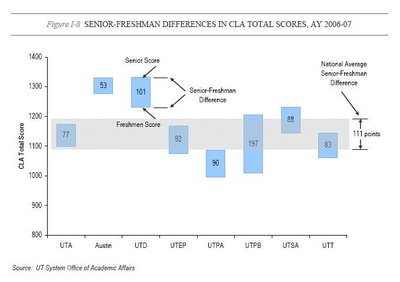
But SAT scores leave the question of college student learning unanswered. It's odd, the way we give colleges credit for how their student did on a test they took while they were juniors in high school. Colleges argue that high SAT scores are an implicit quality signal because they reflect high demand, but the demand may just be for the prestige and the football team and the nice facilities and the chance to hang around with other students who also have high SAT scores. To really get a handle on learning, it makes more sense to test a sample of freshmen and a sample of seniors, and see how they compare. And in fact the University of Texas system has done exactly that, using the Collegiate Learning Assessment. Here's what they found:
Each block on the graph shows two data points: freshman and senior scores on the CLA. As you'd expect, freshman scores correspond fairly closely with SAT scores: Austin and Dallas have the highest, regionals like Permian Basin the lowest, and the rest are in between. Much more interesting is growth. While Austin students arrive at high levels, they don't seem to improve very much while they're in college--the difference of 53 points is less than half the national average of 111 points. This may because of some sort of 'ceiling effect,' or it may be that elite universities don't focus much on improving students who arrive in great shape to begin with. Pan American and Permian Basin have very similar freshman scores, but Permian Basin's growth is more the double that of UTPA -- 197 to 90, bringing students from well below the national average on entry to above it on completion.
RIM's BlackBerry Storm on Amazon

If you're not a fan of the iPhone, or not a fan of exclusive carrier AT & T, then there are a few popular alternatives. If you can't wait for the Palm Pre, you might want to consider this deal from Amazon, BlackBerry Storm 9530 Phone, Black (Verizon Wireless)

RIM's BlackBerry Storm shows its cheaper side on Amazon - Engadget:
Verizon's BlackBerry Storm is getting a little kick in its pricing courtesy of an Amazon rebate-free rebate. The deal here is that the infamous touchscreen BlackBerry is now $99.99 on a two-year stint, no rebate paperwork, no mailing things anywhere, just shell out cash, get phone, call people. Verizon has a buy one get one free thing going on right now, so if you're looking for two Storms for the price of one -- and that one is still $199 -- you can head on over to see them.
Subscribe to:
Posts (Atom)
LinkWithin
